Projects

Saturday, April 30, 2011

The Killing of a Village Chicken


It may say something of my fascination with food that I have given this one activity its own blog. Perhaps it is to alleviate the constant rambling of my life narrative. Or perhaps I feel like I need to respect the life of the chicken that continued to chase me, headless, across my yard. I don’t fully understand why the village chicken deserves its own blog post, but it just feels right.  
In addition, this is should be a somewhat amusing post as I am simply going to get you up to where YouTube can take over. My wonderful roommate Hannah dug through the 30 minutes of raw footage to combine some highlights into a ten minute video.  For some, ten minutes of killing and gutting a chicken may be fascinating. For many of my Vermont peeps (no pun intended), this may be like watching someone make chocolate chip cookies...rather uninspiring. However I encourage you to watch it for the sheer number of ridiculous moments and memorable quotes. They are not highlighted, so you kind of have to listen.
The idea to kill a village chicken had brewing in the back of our heads for a while. They can be seen on the side of the road under domes made of bent branches and held together with twine, or can be found riding around in wooden wheelbarrows in square cages made of the same. However, the idea could easily have fluttered away, forgotten between lion hunts and the temptation of beach paradise. Turns out that sometimes it is just these fleeting ideas that are the most memorable.
  However, the second Sunday of Big Man’s visit had turned out to be rather dull.  We had hoped to change our Monday tickets to Zanzibar to Sunday to gain one extra day of beach paradise. Unfortunately, after a visit to two different offices, we discovered that Zambezi airlines are still learning how to do good business, and we were stuck.  After feeling a little bored and disappointed with a day filled with purely shopping, we hopped into a cab to take us back home.  It was Sunday at about 5 pm. In a country where Christianity is written into the constitution, it seemed that our chances at purchasing a chicken were low, and we had pretty much abandoned the idea. Our night was looking like a movie and bed.
Not to be.  After chatting with the taxi driver, a cultural requirement in Zambia, I happened to ask him if he knew where we could get a village chicken. There was nowhere, he said, that we could get a village chicken in downtown Lusaka at this time. We would have to go the Garden compound. And, of course, he was just the man to take us.  

The non-definition of a compound

In Zambia, ‘compounds’ refer to high density residential areas.  What many may consider as a ‘slum’ would fit under the definition of a compound, but also a neighborhood of dense, middle-class houses may be referred to as a compound. All of my research with orphans and the impoverished take place in ‘compounds,’ but I also have many close friends that live in compounds who are not ‘in poverty.’ I am using these words loosely in order to try and convey the broad definition and connotation of a ‘compound.’  There is no universal definition of a typical ‘compound,’ but when you work with the impoverished, you will probably end up in one.
Some of the more impoverished compounds consist of houses with cement walls and steel sheets as roofs. Many don’t have doors. Residences are not necessarily on a road, and sometimes they are linked together by paths. Roads, when they do exist, were often once paved (under the former president Kaunda) and have fallen into disrepair. I have learned a bit about bad roads since I have been here, mostly from the terrible road that I live on. It is much better not a pave a road in the first place than to pave it and then neglect it for years. Most of the roads here look, at first glance, as if they are only made of sand or gravel. However in reality there are chunks of pavement under the sand, so the rises between the cavernous potholes have the hard jagged edges of concrete. Also, in a normal sand/gravel road, the depth of potholes are somewhat mitigated by the general runoff of the entire surface layer of the road, thus lowering the level of the road in general. Here, sections of old pavement are held solidly at one level, with the water having to go in between. The concrete doesn’t ‘runoff,’ so to say. Therefore you have many deep, deep potholes with jagged pieces of hard concrete in between. You cannot go more than five to ten miles per hour in a 4WD.  Low hanging cars, needless to say, do not last long. 
These kinds of compounds are places that you wouldn’t see while just visiting Lusaka. You would have to be invited into someone’s home or work in them to see to them. Or, you would have to be with a great cab driver taking you to buy a village chicken. It would be uncomfortable, if not risky, to just walk in by yourself.  When people think about poverty in Africa, they often picture circumstances similar to these compounds. Needless to say, we had been trying to figure out how to get Mark in to see these places as they are similar to the places that I work when I am in the field. They are not places you would just enter. My roommate Casey described it well to Mark. You wouldn’t just walk into a compound to look around, just as you wouldn’t go walk into the Bronx in New York City just to look at it.
So, when our cab driver Sam offered, we jumped. We sped home to drop off our purchased items. My roommate Hannah, who is my cooking guru and future chef of the Zanzibari restaurant I will someday invest in, was innocently standing in the kitchen as I dashed in and dropped my things. I yelled from my room to get ready. We were going to the compound to buy a village chicken. As expected, she was perhaps the only person of my six person house who was as excited as I was.  And then we hopped into the cab were off to Garden compound.
The buying and killing of a village chicken

                Despite my long definition of a compound, our trip was uneventful, except that Mark got to see a compound. I had never been to the Garden Compound, so it was my first time as well. The Garden compound is about a seven minute drive from my house. My house, for those of you who don’t know, is a mini palace. My program initially placed me in a modest house, but my landlord/roommate Virginia moved us here about two weeks after I arrived. The main house that I live in is enormous. There are six bedrooms, an enormous kitchen, and three bathrooms. It has a dining room, living room, garage, and a veranda that has a tiled floor and is enclosed with white metal grating with intricate designs. The veranda leads out to the back yard, which contains an in-ground pool and a huge avocado tree. Behind that, there are three other buildings which are rented out as residences and to a business.  The entire thing is enclosed by a wall, which is the way houses are in Lusaka. We have a flat screen TV, DVD player, etc. I am not living in a thatch hut in rural Africa.  Although it is one of the nicer houses on the street, it is surrounded by other residences that are similar.
                Seven minutes from this, it is a different world. The contrast was startling. We were still talking to the Sam the driver about how much a chicken would cost as we turned off the main, paved road and headed Garden compound. I had passed this side road hundreds of times without as much as a thought. Suddenly, the walls that shield residences from view were gone, as were household doors. While the main roads of Lusaka are dominated by cars, the road into the compound was dominated by people. You could see hanging laundry everywhere. It was different than the more rural compounds that I work in in the field. It was busier, and slightly more built up. Not five minutes in, we turned into what I can only describe as Zambian compound strip mall.  Sure enough there was a woman in the parking lot selling chickens out of the typical wooden cage. Though it was five o’clock on a Sunday, there was music blaring, full blast, out of a little bar. People had clearly been drinking all day. The driver explained that those who are unemployed often drink all day, every day, if they can afford it, and the bars are open early in the morning. Despite the typical strict observance of the holy day which closes almost everything else, the regulation of alcohol on Sundays is clearly an American gaffe. Our driver hopped out of the car, explaining that as mzungus we would be charged triple the price, and went to go discuss the chicken with the woman.  With lots of looks and gesturing towards our car, and after attempting to give my best ‘I may be a mzungu but I know how things work here Auntie’ look,  a fine looking live chicken was finally sold to us for the price of 20 pin, or approximately 4 dollars.

The Village Chicken

The Village Chicken....Alive
                As you may have noticed, we specifically bought, killed, and ate a village chicken. In Zambia, there are two kinds of chicken. ‘Chicken’ refers to the chicken you buy at the grocery store, prepacked. You can’t get village chicken in the grocery store. ‘Village chicken’ refers to the chickens are that bred and raised by Zambians in the villages or compounds. Village chicken is preferred by many, and it is quite different for many reasons.
                Many people probably already know about this little explanation I am going to give, especially the VT readers, but for those that don’t, here it is.  American’s have created a new chicken. The chicken that we eat, the Broiler chicken, is a far cry from the chicken as God/evolution made. We like white meat, and in particular the tender white meat from the breast. So, using intense artificial selection, we bred chickens into a different body type. The breasts of Broiler chickens are largely exaggerated, and the legs are vastly shorter. The actual proportions of the body are different. And, obviously, intense hormone injections make their bodies plumper. The muscle is more tender, body fat concentration higher. There are actual some physical problems that chickens have because of these unnatural proportions. This is essentially all that you can get in American supermarkets.
                However, Monsanto and Price Chopper haven’t reached the chickens raised in the villages of Zambia. These are chickens that have not been bred for white meat. They have not been hormone injected to be fat and juicy. They are, indeed, a 100% natural chicken. They are tougher, darker, and smaller, and as you will see, they look slightly different.
                And with that, I simply hand you over to YouTube. Again, lots of good quotes moments. My favorites? “It’s like….chicken skin…” There were also some that out were cut, most likely out of the impropriety of the low cut of my pajamas. So you miss, for example, such nuggets as when I disagree with Mark over whether the chicken was actually dead as he is holding its head in its hands, or when I pet the chicken and tell it that it’s alright as its headless and convulsing on the yard. Those aside, there’s plenty more nuggets…chicken nuggets….sorry, couldn’t resist. Enjoy!


 REMEMBER: IF YOU CAN'T KILL IT, DON'T GRILL IT!


He's psyched

Post murder

That cat joined too...Beth, we put that knife to good use.     

Cooks at work.....

Village chicken and...cupcakes? Oh, and this was after we decided it was a good idea to try and start a fire in the driveway to burn the remains, failed, left remnants of fire/chicken remains, and then tried to 'smoke' the chicken...also failed.....


Tuesday, April 19, 2011

Big Man arrives, and you can't escape Disney


There is a good reason for the gap in my posts. My past two months have been spent in room 14 of the ZCARHD office preparing for the second round of data collection and cleaning up the last bits and pieces of data from Round 1.  Not much to write home about, literally. My office is like any other office, except with unreliable internet. No gripping insights there. Everyone in world wants to go Office Space on the printer, and everyone in the world has office politics. We may all worship different Gods, but at least we can all agree as one human race on the main components of the office.
However, my time in Lusaka has enveloped me in the expat scene here, which has, in turn, been wildly fun, fulfilling, confusing, and frustrating.  There is something addicting about hanging out with a motley crew of Danes, Dutch, Nigerians, Canadians, African Bushmen, and Zambians.  It will require its own post, so I will leave it for later.
           Needless to say, after two months of office days and Lusaka nights, I was very excited for my leave and very excited to see Mark. He arrived on Saturday April 2nd after a smooth flight, (sans luggage), and we spent a couple of days tootling around Lusaka. He was called Big Man by about every Zambian he saw, and our tour around Kamwala market ended with Big Man and I trying Shake Shake (previously described vile concoction of fermented mealie meal) with a group of  charming and perhaps drunken Zambian men. It is amazing how fast a crowd gathers to watch mzungus try Shake Shake. If he was missing home at all, this was abated when we continued on to a bar  with a live band covering Michael Jackson songs. Good old MJ, yet another globally unifying factor.
                Then we hit the road to embark for a bush adventure. Thus begins part 1.    
               
Simba, Rafiki, Zazu, and more…

               
Monday morning saw us heading down to Livingston, in Zambia, to depart on our journey into the bush and to see the falls.  We saved the falls for after the safari, but we did embark to the Royal Livingston Hotel for a drink at sundown. If anyone ever wants to understand British Colonialism, visit the Royal Livingston. You drive through the typically African town of Livingston to get to a gated, royal palace.  We entered the gate, and behold, there were zebras just hanging out on the lawn. We immediately started talking in hushed whispers, thinking we were blessed with a chance encounter with this beautiful wild creature. We whipped out our cameras and asked our taxi slow down. He indulged us for about five minutes before calmly explaining that they were pet zebras kept by the hotel. Right. Stupid mzungus.


Spray from Victoria Falls from the deck of the Royal Livingston
 We then descended through a yard of scampering baboons to enjoy drinks on a deck that is literally in the Zambezi River.  It is positioned right before the edge of the falls. You could see the spray coming up over the edge. It was absolutely beautiful, and decadent, and Caucasian. We enjoyed a completely overpriced drink, which was actually listed in US dollars instead of Kwacha, before deciding that we had had enough. We booked it back to Livingston and walked through the bustling streets and markets at night. It was an invigorating experience I have been previously unable to enjoy due to the lack of a tall, fit, and let’s all admit it, rather handsomely fearsome looking male bodyguard.  We ate dried caterpillars, drank liquor out of a fun pop bag, and called it a night.
               
The next day we departed for Botswana, and entered the realm of the Lion King. When I say that, I mean it literally. Throughout the safari, when discussing animals that were graced with a lead role in the movie, our Botswana guide referred to them by that name. “There’s a zazu. There’s a rafiki.” (This drove our companion from Kenya insane, as he kept insisting that in Swahili Rafiki means friend, not monkey.) When describing the mass charges by buffalo, he would say “Like in that scene, in The Lion King.” Excuse the slight distortion of images. Resizing saves me hours, but not the best quality.

My favorite view of Chobe
We stayed on safari for two days and two nights. The park was Chobe National Park, which is known for its massive herds of elephants.  It is a large park, and we only saw the very tip. The park itself consisted of the Chobe River, which was overflowed during rainy season, and the dry lands. There were thus two different landscapes to observe wildlife. The river was amazing. There were just strips of green grassland among sparkling blue waters, and elephants and hippos were just roaming next to each other. The grasslands, however, had the most wildlife. We explored that particular part as the animals were forced to the river for water.


Our camp was six simple tents surrounding a fire. They were arranged in a semi-circle, with lanterns behind them. This was to orient them as a herd, to warn animals. The food was cooked by the safari team and was delicious. We were not permitted to walk too far outside the camp at night, and if we needed to use the drop toilet in the night, we were to call one of the guides for an escort. The camp was also equipped with a shower consisting water warmed in the sun and hung from a container with holes in it from a tree. Perhaps the most refreshing shower I have ever taken (can't post the pictures from that). We often had baboons, elephants, and impala simply stroll by in the mornings. 

The bush camp. Our is the one closest to the camera.

 Chobe has about 55,000 elephants within its border.  I have never experienced elephants in such a way before. They were just everywhere. We saw them swimming, eating, washing, dusting themselves (which they do after swimming to dry off), playing with babies, and we even saw an elephant baby that was only two or three days old. We had one get angry at us, and truly understood how scary and dangerous they actually are. They also have incredibly human characteristics (or, should I say, we have incredibly elephant-like characteristics.)  I don’t think I will ever be able to see an elephant in captivity again without my heart shedding a tear. They just belong in a place like Chobe. 
Mama Ele, Pap Ele, and Baby Ele

Dusting after a swim

Two day old elephant nursing

Peekaboo

  We were also lucky enough to see leopard, which is an extremely rare sighting. I actually couldn’t really see it with my bare eye. I needed the camera lens, and mentally thanked the salesmen in BestBuy who sold me on that digital zoom. It had apparently climbed the tree because it was scared of the nearby lions. Who could blame it? I also gained a new respect for giraffes. They are so incredibly graceful, and when they run it looks as if they are running in slow motion. That said, they can actually outrun many of the predators of the bush. They quickly rivaled the elephant as my favorite animal.
Lucky us!

Just another elephant
After day one, the group fell prey to the well-known symptoms of ‘been there, done that.’ We had so many elephant encounters that we soon got impatient when we had to wait for the elephants to cross the road in front of us. We saw so many impala and buffalo that we stopped even noticing them.  By the end of day two, you could tell how fresh another ‘rival’ safari truck was by observing which animals they were looking at. If they were observing impala, crocodiles, buffalo, elephants, or baboons, they were total amateurs. Freshmeat.  We, the more experienced and wiser safari team, were on to more important things: tracking lions.


The Lion King (or Queen)

Chobe is different than other national parks in Africa for a couple of different reasons.  First, there are no walking safaris allowed. In many parks you can trek with an armed guide through the bush to observe the animals. Secondly, there are no night drives allowed, which is when the lions are most active. And last but certainly not least, you cannot off road in Chobe.  This is the most significant difference. In most parks, you can slam your 4WD off the beaten path and go rumbling through the bush in search of wildlife. In Chobe, you must stay on a network of sand roads and view the visible areas. 

 At first, these all seem like negative differences.  I can just hear the thousands of diehard travelers whining ‘but then you can’t truly experience the African bush.’  I, as well, was worried that we wouldn’t have as good of an experience for lack of these opportunities. However, once there, I realized that these rules are part of what make Chobe so special.  Tourism is an important financial support for national parks, and as such, they strive to make visitors happy. Sometimes, you wonder who the park is actually for, the animals, or those that come seeking to see these exotic creatures in their natural habitat.  In Chobe, however, the park is for the animals.  You don’t get to off road into their habitat. You don’t get to track them by foot and put your scent everywhere, and you don’t get to disturb them at night when some of the most fearsome predators are hunting. In appearance, it looks as if the mark of humans is all over the park. The vast network of trails and the frequent encounters with other safaris reminds you constantly that you are neither the first nor the only visitor. However, you are stuck in a car on the road, and there are miles and miles of wilderness that you cannot touch. Thus, the wilderness of Chobe is preserved for the animals, and it is clear that the purpose of the park is for the wildlife. Perhaps we missed the experience of off-roading to find lions sleeping, but if everyone did that, would it really wilderness?  Would it really be a ‘sanctuary’ if there is no reprieve from the rumbling of safari trucks?


Lion cub tracks in the road
I bring this up because it is entirely relevant to the tracking of lions. Lions are brilliant at hiding themselves. They almost perfectly match the grass on the savannah.  Most of the places they can go in Chobe, you can’t see them. So lions are not a guaranteed sighting, and the tracking of lions is made much more difficult when you can’t rumble into the bush after them. Instead, you watch the sand road for tracks that may have crossed, and try to head to the other side of the flatland to see if they cross before you. Or, you listen to the baboons screaming and know that means that they have seen a lion, and you rush as fast as possible. Or, when an impala runs in front of you at full speed, you look to see what it is running from.
               
Camouflage
 Tracking lions is invigorating. Lions stick to the road, so you can follow their tracks. You judge how fresh the tracks are, how big the lion is. And when you find a lion or two, as we did, it’s absolutely petrifying. We rolled around the corner to find a female standing on an outcrop above us. Being in an open truck doesn’t make you feel to secure when you are 15 feet away from a lion staring down at you. To add to this affect, they often keep their mouths open to cool themselves off, thus exposing their enormous teeth. However, by far the most chilling lion encounter was watching lions on the hunt.

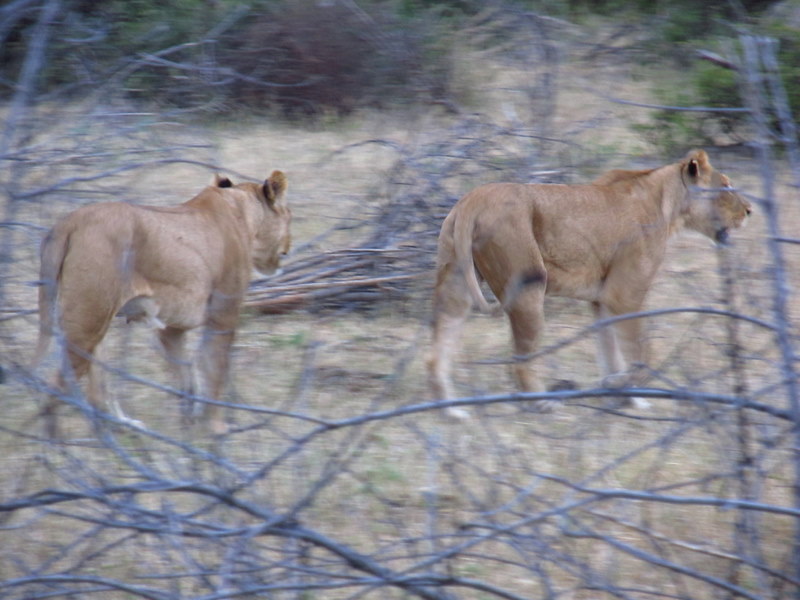
 We ran into two more females later that day, and they were hunting together. The walked, side by side, in perfect sync, through the long bushes. Then they saw us.  They stopped, both of them at exactly the same time, to turn and look at us. So, here we are, staring straight into the eyes of two female lions on the hunt. There was a couple seconds of silence, and then, in perfect sync, without looking at each other at all, they turned their heads forward and kept walking. They even started with the same paw. It is impossible to recreate the absolute synchrony and focus of that one moment. I felt deep pity for every one of the thousands of impala we had just passed. On the way home, the buffalo herd nearby had just started running. We heard them roaring to announce their kill to the male from our camp about two hours later. 

The hunters

Dignity embodied
                 
The Plunge and the Plume

After saying our goodbyes to the African bush and our leaving our poor guide in the hands of some dubious Americans (we all know the type), we departed back to our hostel and made our way to the famous Victoria Falls, the Smoke that Thunders, the Mosi-au-Tunya, the jewel of Zambia, the UN world heritage site, and most importantly, the namesake for my favorite Zambian beer, the infamous Mosi. 

I am made quite sure that the falls themselves are a spectacular sight. Unfortunately, we did not get to actually see the falls due to the booming sheet of spray that literally made them invisible, save for lucky breaks in the mist.  It was absolutely awe-inspiring, invigorating, and wet.  You could feel the absolute power that produced that spray, and stand at the edge of it.
Feeling the power
 The real invigoration of the day, however, came from other sources. The Victoria Falls Bridge at the Zim/Zam border hosts the second highest bungee sight in the world. You plunge 111 meters down towards the Zambezi. The bridge is literally known to exist in Zim/Zam, as it is in the no man’s land between the two borders.  No, I absolutely did not jump off that bridge in no man’s land in Africa. My tall handsome body guard did. That man is one crazy %#5) $*)@#.  I think the pictures say enough, and yes we have it on video. I will add that I was too chicken to even stand on the bridge and look down at him as he fell. I had to watch from a distance.
The jump. In the video, I am saying 'holy shit, holy shit, holy shit....'
The rise after survival
WINNING!


Thus ended our adventures….kind of.  Except that the next day all the buses to Lusaka were full.  Going on trusted advice, we decided to hitch it. Great decision.  Hitching has its own culture in Africa. Some people pick you up for free, and some people charge you, and everyone does it. There are literally pick-up points with 20 Zambians with cargo waiting for a ride.  We were forced  to keep going further and further out of town to escape the crowds of people waiting for a ride, but we finally got picked up in a minivan packed with people. Mzungu effect: we got the front seat, which was massively more spacious. We also got to sit next to the driver, who happened to be the owner of one of the larger fleets of coach buses in Zambia. It was actually his bus that had been sold out that morning.  Only Africa do you get blocked by the bus, but picked up by the owner of the fleet! We were lucky, as we soon realized that it was the end of school and the roads were jam packed with people trying to make it to Lusaka. The issue with hitching, however, is that the police regulate it at checkpoints and fine the drivers. Luckily for us, one of our passengers happened to actually be a cop, so we learned the magic words to get through the checkpoints no problem. As we often say in these situations, TIA. This Is Africa.

And, we arrived home safely. Thus ends part one of our adventures. Here are some random pictures. LOVE TO ALL!

I LOVE GIRAFFES!


On a game drive

On a game cruise on Chobe River

Sunset at Royal Livingston
Sometimes it's the small creatures that are the most amazing.


Monday, March 7, 2011

Nc-wala

  Hello friends and family! Blog entry three.  I think that means I am officially a blogger. I am already imagining my growing cadre of fans.

I had meant to elaborate on my experience in the field in this entry, but amazing events have made me push it back a bit. Last weekend I undertook an epic journey to the Nc–wala festival in Chipata, a town about  7 hours north of Lusaka. I say epic because the entire thing involved little sleep, no showers, and a terrifying bus ride. However, it was one of the most rewarding spontaneous trips in my life.

My roommate Casey getting wild
I was accompanied on this journey by my equally crazy and adventurous roommate Casey and my work mate and friend from Boston, Alla. We each packed a small back pack Friday and departed for a party at our friend’s house, which somehow ended up looking more like a masquerade than a chilled out dinner party. Our bus departed at 4:00 am, so at that point it is really not worth going to bed.  We proceeded to board a seven hour bus to Chipata 3:00 am.  Seeing as we had wet hair from a dip in the pool, were covered in glittery things, and were perhaps a bit too giggly, I would rate that particular moment as a Triple Muzungu Effect moment. 

This was my first bus ride in Africa, I learned a couple rules governing the operation of these vehicles.  If it is dark, that obviously means that you have to drive in the middle of the road. Since you are in a top-heavy bus,  that clearly indicates that you should actually speed up when going around turns.  And, last but not least, if is pouring rain at 4:30 in the morning and you can’t see the road ahead of you, that means accelerate.  God and I re-united in the early hours of that bus ride. I also learned the reason the seats under the vents were empty were because the rest of the bus knew that in the pouring rain, vents leak. A lot.  Thus you have Alla and I (Casey having done the wise thing of putting herself out of her misery by going to sleep) with a rain coat and chitenge over our heads, hiding from the rain on the bus, and praying for our lives. Damn muzungus.  Despite all of our preparations to sleep on the bus (namely, alcohol) there was no sleeping for the first three hours.

I woke up to be dropped in the middle of a field with thousands of people and tents. We drag our poor selves to find a bathroom, and are led to a port-o- potty. Now, I have dealt with port-o-potties before.  In fact, the difference between an African festival port-o-potty and a port-o-potty found at a Phish show is merely the color. Alas, shit is shit. However, this being Africa, the birthplace of the majority of microscopic beasties, we decided to take our chances in the bush.  We confidently wandered into a weird, overgrown cemetery. Of course, it turned out to served the same purpose as the port-o-potties.  It’s amazing how acclimated I have become to the smell of poop.  Family germophobes, I can almost see you cringing.

Anyways, after changing, deodorizing, and waking up a bit in this weird overgrown cemetery/potty in the bush, we walk into the festival.  We are clearly in the drinking section, which inspires me to say a little word about a thing called Shake Shake. Shake Shake is the local, cheap alcohol. It comes in a milk carton. It is made by essentially putting mealie meal and water in a hollowed out gourd and letting it sit for a couple of days.  Apparently mealie meal is considered a staple for more than just its nutritional value. It somehow ferments and turns alcoholic.  It unfortunately also starts to smell like puke. Strongly. And it is thick and white.  I am literally nauseous just thinking about it. So when you see someone totally drunk with white stuff spilled down their front, you really don't know what it is. Everyone was drinking Shake Shake.

I don't think these would make it past customs.
Now a little more context about Nc-wala (pronounced Nich- wala.) Nc-wala is a harvest festival of the Ngoni people in the Eastern Province of Zambia. I essentially went because they sacrifice a cow by stabbing it and the paramount chief drinks its blood.  How could I miss it? And to think I was once a vegetarian…The Ngoni do these tribal dances and dress in traditional tribal dress.  They wear headdresses and skirts made of pelts.  The pelts they use were often of cheetah, zebra, and other animals that were clearly illegal and poached. You can see some in the pictures.  So the attendees at the festival were all wearing these pelt head dresses in celebration of Nc-wala.

Being three Muzungu girls, we were stopped about 2 minutes after entering the festival by a couple of young Zambian men, and being the nice ladies that we are, we started talking with them.  Before you know it the cameras are out and we are taking pictures with absolutely everyone and wearing their headdresses.  We make friends in particular with these two guys that seem at least half sober and not as obnoxiously hitting on us.


Just at this moment it starts to pour.  Of course none of us actually brought our rain jackets to the middle of the African countryside during the rainy season, so we dash for cover. The problem was that so did everyone else. After nearly getting knocked down in the shoving that occurred to get under a roof, our new friends guided us to the police tent and spoke with the police.  Muzungu Effect: We are allowed to stand under the police tent while everyone else gets wet. Did I feel a little bad?  Yes. Was Casey wearing a white silk shirt that really would have looked rather thin when wet? Yes. So we stayed in the police tent with the “prisoners” from the festival and some guy bleeding from the head that walked in. This seemed completely normal.

The rain let up and we try to go over the actual ceremony, which takes place within a walled yard. We go to the first doorway and are denied entrance by members of the Zambian military.  We go to the second entrance, and our new guides get in through the guards to find one of his friends working in the press. He gets us in! Yes! At this point, the cameras are out. We work the camera thing and are soon ushered up front to take pictures.  Alla has a big digital camera, and before you know it she had gone right up to the press only area and was ten feet away from President Rupiah Banda taking pictures! She made friends with a press agent, and suddenly we were ushered front and center. Muzungu Effect. We were treated like press, and we didn’t dissuade anybody. We must have been in front of thousands of people, taking premium pictures. 
Awesome. 
Ngoni in traditional dress


 But it just gets better. On both sides of the stage are hundreds of Ngoni in full tribal dress. They see us taking pictures, and they want theirs’ taken. The ability to see their pictures on the screen is just too much fun.  Soon we are taking pictures among the crowd of people actually taking part in the ceremony.  We were there for about 45 minutes snapping pictures and joking across the language barrier. It was by far the most amazing experience I have had in Zambia to date. You can see from the pictures that the women are topless. Only older women are allowed to expose their breasts. If a woman can still produce milk, it is inappropriate to show them. It is only after one is done having children that this becomes acceptable. 
 
Digital camera = lots of friends
                              
After we get tired of pictures, we get back to our press spots in time to catch the final dance. Again, as close as we can be. I was self-conscious because we are being watched by so many people. I have amazing video footage, but I do not have the patience to upload them.


After all of this, the bull had yet to be killed. We were front and center but couldn’t see much as we had to sit down so that others could see. I saw the first spear go in, but didn’t get to see anyone drink blood. At that point though, it was inconsequential. We had such an amazing time, I would have been happy to leave right then. We left the ceremony and ate some nshima, and then our new friend took us out of the festival and into the actually village that hosted the festival. On the way, we ran into one of the women we had taken pictures of.  Her family camp was making a huge pot of nshima over the fire. There is a very a particular way to stir it with the cooking stick, as you can see from the video, and they let us try it! I may have burnt their nshima. 
I never was good at cooking.


We continued on and had a nice rest in a field, as at this point we were exhausted. We were on our way back when our friend ran into two of the chiefs, who gave us a ride back to town (Muzungu Effect). Essentially, we arrived dirty and hung over on a bus, and got a ride back with not one, but two chiefs. Not bad for one day, in my opinion.

Now, after I have recounted the most amazing day I’ve had here thus far, allow me to of expound some of the darker aspects of Nc-wala and some cultural practices that I learned about during my visit.  Every Ngoni village has a chief.  As many of you know, tribal lines in Africa supercede national lines. Thus, when I say Ngoni, I am referring to Ngoni tribes in Malawi, Tanzania, Zimbabwe, etc. So, ruling all of those chiefs is a paramount chief. He is the one that drinks the cow’s blood, and he is believed to have connections to the spirits. He is treated like a king of sorts, with body guards, multiple houses etc. He has been chief for around 40 years.

Every year at Nc-wala, the chief is allowed to pick one virgin girl from the village. This girl is required to ‘entertain’ the chief that night. Although there is no legal repercussions for refusal, the elder women in the village will ensure that this young girl complies. There is no marriage or any kind of compensation, just this one night. After this night, the girl is ruined. Her prospects for marriage are dashed. You may think that this is because she is no longer a virgin. Not the case. The reason is heart breaking and an example of the struggles that Africa faces. The paramount chief is HIV positive. He has been sick for years, and everyone knows it. However, tradition is tradition, and so the practice continues.  No one will marry the girl for fear of getting sick. I think this is such a telling example of how hard it is to combat the virus in Africa in the face of so many conducive cultural practices.

There are also some other interesting cultural practices that surprised me. I had assumed that girls being virgins at marriage was important here, as it often is in cultures where women are repressed. Not so. In fact, there is a practice I was told about that ensures that women are NOT virgins. Apparently, there is a man in the village called a “hyena” that is responsible or determining when a girl is ready for marriage. He does this by sleeping with her when she is around 12-13 years old. He will then make the decision.  Can anybody think of a better way to spread an STD?  Frankly, I was horrified.  These practices are only in the very rural areas, and also seem to be fading out, but still shocking.

Our trip ended rather uneventfully. We stayed in a self-contained room that we couldn’t leave without the assistance of the attendant because of the guard dog outside (exactly who was he guarding, anyways?) We then got to wait until about 12:30 for 10:00 bus to depart, but that’s the way it goes. All in all, it was an absolutely amazing weekend!

Thus concludes entry 3. Love to all!
She's saying "its a weapon, not a magic wand."

These boys were posing for us.


Believe it or not, they asked us to take a picture with them


Amazing


Sunday, February 20, 2011

The Nuts and Bolts


Hello and welcome to post two. So far so good with keeping up with my blog.  Thanks for all of your support and encouragement!  

To begin with, most of you know that I have just returned from three weeks ‘in the field.’ I should qualify that term. I was not staying in a tent with mud floors. I was staying in a lodge with a private room, TV, mini-fridge, cleaning and laundry service, and intermittent hot water. (Actually, intermittent water in general. For the first time, my excuse for being late was ‘The water stopped and I was covered in soap and had to wait for it to come back on.’  I have never used THAT one before.) I just want to debunk any visions of me sleeping on a cot among lions. Nowhere near.  In fact, the first room I stayed in looked like, (and I am sorry for using this description with family and making you feel awkward, but there is NO other way to describe it) a scene from a really bad 1990’s adult movie. The picture is above, complete with mosquito net, but it doesn’t really do it justice.  Let’s just say the entire room was dark red (including plush carpet), and all the fabric was shiny, shiny, shiny. It also had a huge heart pillow studded with sequins among the 20 throw pillows on the bed.  Just saying.
So, to give some context to my field work, I am going to dedicate this blog post to giving a brief description of my project and my work for those of you who I haven’t already tortured with the details. (And Mark, because I know that you will NEVER get around to reading my protocol).  Then next post I can break into all of the fun stuff and you will know what I am talking about.  I apologize, it’s rather boring, but necessary to understand the context of my work.

My study is called the Longitudinal Study on Orphans and Vulnerable Children, or LOS for short. Let me break that down a little.

 Longitudinal means over time.

An orphan, in Africa, refers to any child that has lost EITHER parent. In fact whenever you are reading any orphan related statistic from the WHO, USAID, etc., you should keep in mind that they are using this definition. While this definition may seem to decrease the severity of the word ‘orphan’ in comparison to our definition, you must also understand that the context is different.  Consider the severe shortage of income generating activities available to any given household.  In the States a single parent can often manage to at least get by.  In Africa it could mean starvation. A child can be a paternal, maternal, or double orphan. As you can imagine in a country with a 1 in 5 HIV rate, there are a lot of these children.

 A vulnerable child is one who has HIV, or some other extenuating factor which increases their vulnerability.
Together, these children are referred to as OVC’s (Orphans and Vulnerable Children).

Caregiver and children in Kafue
This study is one of the first longitudinal studies on orphans in Africa. I am not sure that there have been any published results of a similar kind of study.  The main reason, I think, is that tracking the same children over time is very difficult.  We attempted to find the same children that were interviewed in the program evaluation conducted last year (more on this later) and it was very challenging. Just trying to match the names is near to impossible. Names are very fluid here. People have two to three names that they use interchangeably, plus names they use with muzungus (On the last day in the field I learned that one of my dear friends was Chisiah, not Maynard. Go figure).  In addition, spelling is purely phonetic. This means it can change depending who is writing it down and how they hear it. R’s and L’s are mixed up as a rule. So, Lejoi and Rejoi...same person.  So, one thinks, let’s just look at the birthday. Also problematic.  Of the 200 or so children that we did track from the last study, there were about 5 with the same birthdays as they listed a year ago. Most were off by at least a year. My feelings on the effects of not tracking age I will save for another post. (Hint: I like it). So, to get back to the point, it is difficult and time consuming to track these children over time. Therefore most studies that look at the conditions of orphans are cross-sectional, a one-time evaluation that really only yields results of association, not cause.

Moving on. The goal of the study is two-fold. The first is a kind of evaluation. When Bush, in a rare moment of insight (apologies to those in Florida and Texas), gave Africa millions of dollars in aid, he did so under the Presidents Emergency Plan for AIDS Relief. This is commonly known as PEPFAR. In Zambia, this was distributed through a program called Expanded Church Response. Essentially, money to assist OVCs was funneled through local churches because they already play such a vital role in Zambian communities. Christianity is actually written into the Zambian constitution, and Zambians are very religious as a rule.  

Last year, at the end of the first five year PEPFAR grant, my office conducted an evaluation of the program to see how orphans were faring in comparison to other children. This was a cross sectional study, with rudimentary results. Thus, my study was funded by PEPFAR in order to create a cohort of children that we can follow over time, to truly understand what is going on. This is an extension of the evaluation in some ways, but is also designed to better understand the different levels of vulnerability in orphans compared to regular children. It looks at six domains: Education, Health, Nutrition, Security, Shelter, and Psycho-social development. Socioeconomic Status is kind of an all-encompassing seventh domain.  So far, it seems the differences are substantial.

Half of the team before departing.
The study consists of quantitative and qualitative methods. For quantitative, we trained about 19 quantitative data collectors to conduct interviews on random selected beneficiaries of the funded church’s services. For those of you who are interested, we are using the Teleform software. They then find three comparison children within the community of the same gender and age range. In all, there were around 1300 households interviewed, and each interview takes about an hour. It was quite an undertaking. We split into two teams and went three locations, Kafue, Chingola, and Luanshya (see map.) I went south to Kafue, and then met up with the entire team in Luanshya.  My part in the quantitative research consisted of keeping an up to date electronic database in Excel and tracking all of the follow-ups we had to do, as well as reviewing questionnaires for completion.


Room for Focus Group Discussion.
I am the team leader of the qualitative research. I work with two amazing Zambian women, Helen and Nomsa, to conduct Focus Group Discussions regarding the program and people’s living conditions. I got to train them on my third day in Africa. Note: I have NEVER conducted qualitative research or Focus Groups. Read the appropriate section of the guide the night before each training day. However, we managed. Helen and Nomsa essentially kept me alive and safe, and were my guides throughout my experience. I got to go places I never would have gone alone because of them. We spent A LOT of time together, and I love them both dearly.


This is the 'road' where one of our participants lived.
Each Focus Group consisted of arranging logistics (such as driving around on bumpy roads for three hours in the hottest part of the day in a 4WD with no air conditioning), Helen and Nomsa conducting the FGD (Focus Group Discussion) for an hour and a half, then spending countless hours listening to the recording and translating the discussion in my hotel room.  I have learned that transcription puts me to sleep faster than any sleeping pill. Incredibly tedious. 


That is the brief overview of the study and my job description in the field, and enough for one post! Tristan and Gabrielle, the next post will have some pictures of my house.

Love to all!


Wednesday, February 16, 2011

The Muzungu Effect

Hello friends and family! Welcome to my new form of communication. Perhaps now that I have an official blog with a fancy name I will be better about writing. Nobody keep their hopes up, but I am feeling inspired. I figure that in two years I’ll get a book deal and leading role opposite Meryl Streep.

The Muzungu Effect:
It is a well-known fact that when you travel you often learn more about where you are coming from than where you are going.  It is kind of like being able to look through someone else’s eyes at yourself, but on a cultural level. That said, let me share with you my latest observations of our wonderful country, as it relates to the title of my soon to be famous blog.  What makes America (and other Western countries) unique from the rest of the developing world is that when you are standing at the back of a crowd and you look forward, everyone’s hair is different.  Seriously, number one difference.  You don’t realize how unusual this is until you are in a crowd where everyone is African (or Indian or Thai or Hispanic....you get the idea). I literally think that the most noticeable difference between the developing and the Western World  are the moments at the back of the crowd, when all the heads in front of you look the same. The whole 'melting pot' thing is not a joke.

This brings me to the title of my blog. You can imagine, given my observation, that in Africa I stand out. Just a bit. Not only am I white, I am whiter than the average white (some have said that I glow).  Thus, as a background to anything that I am doing, you must imagine that everyone is looking at me, or at least aware of my actions. There is never a second that there is not someone watching me. I went to a large and busy market the other day with two friends, and getting split up from each other was not a big concern, because at any time, any person could tell you where the other muzungus were (although the amount of grabby hands was an incentive to get together). They are just aware of your presence and your actions at all times.
Obviously, people often treat you differently, for better or for worse.  The obvious: I am immediately considered rich, which means I am immediately a target for begging, both overt and subtle.  Other effects? I am immediately a bad dancer. I clearly need protection from the hardships of African life, and I can clearly pay about twice as much for those tomatoes than my friend Helen. There is definitely some resentment, and I have definitely been taunted in the field (there is a traditional belief in rural areas that white development workers are Satanists). I was also flipped off by a 10 year old in front of my whole team.  It took all my self-control not to do it back and stick my tongue out. You’ll be happy to know that at the age of 25, I resisted.  However, there are also good things, and amusing things. No one ever forgets my order in a restaurant. When I call a taxi driver from last night, all I have to say is ‘I’m the Muzungu you picked up last night,’ and he immediately knows where to find me. And I am automatically perceived as an expert in just about anything. Oh….and yes, all muzungus look alike. No joke.  

 These things I have collectively termed 'The Muzungu  Effect,'  and it has become vernacular among my Zambian team members (who have been quite amused by the antics we have encountered) and among my fellow muzungu friends. You can also have a Double and Triple Muzungu Effects (DME or TME) depending on what else you are doing that is completely against cultural norms. For example, consider if I were to go running.  First, I am white. Muzungu Effect. Secondly, I am a white woman wearing exercise clothes. Double Muzungu Effect (DME). Third, I am running  in a place where NO ONE runs. Triple Muzungu Effect (TME). Thus we can rate our questionable activities rather well.

The wonderful thing about The Muzungu Effect is that it just keeps growing. Every day I discover something new. And while it is a phrase coined in humor, it also has a very serious roots because every time I discover an aspect of The Muzungu Effect, I am also getting closer to understanding an aspect of Zambian culture as it truly is, and not as a foreigner would see it. In other words, by being aware of the differences in treatment, I am at least being aware that of the ways in which my experience is not the norm. Thus I thought that it would be an appropriate name for my blog, as hopefully I will learn more and more about Zambian culture as it is, and not as a foreign tourist.

Stay tuned. To part, some pictures, because everyone loves pictures:
This was my favorite place to buy vegetables on the road from Luanshya to Lusaka.


One dollar buys a whole bowl of whatever they are selling.
 And closer to home, this is my food cabinet as of right now, the 15th of February. With my off hours schedule it has been hard to make it to the market. Thus the past two days of consisted of coffee, bread and peanut butter, and beans.
This is worse than college....
Love to all!